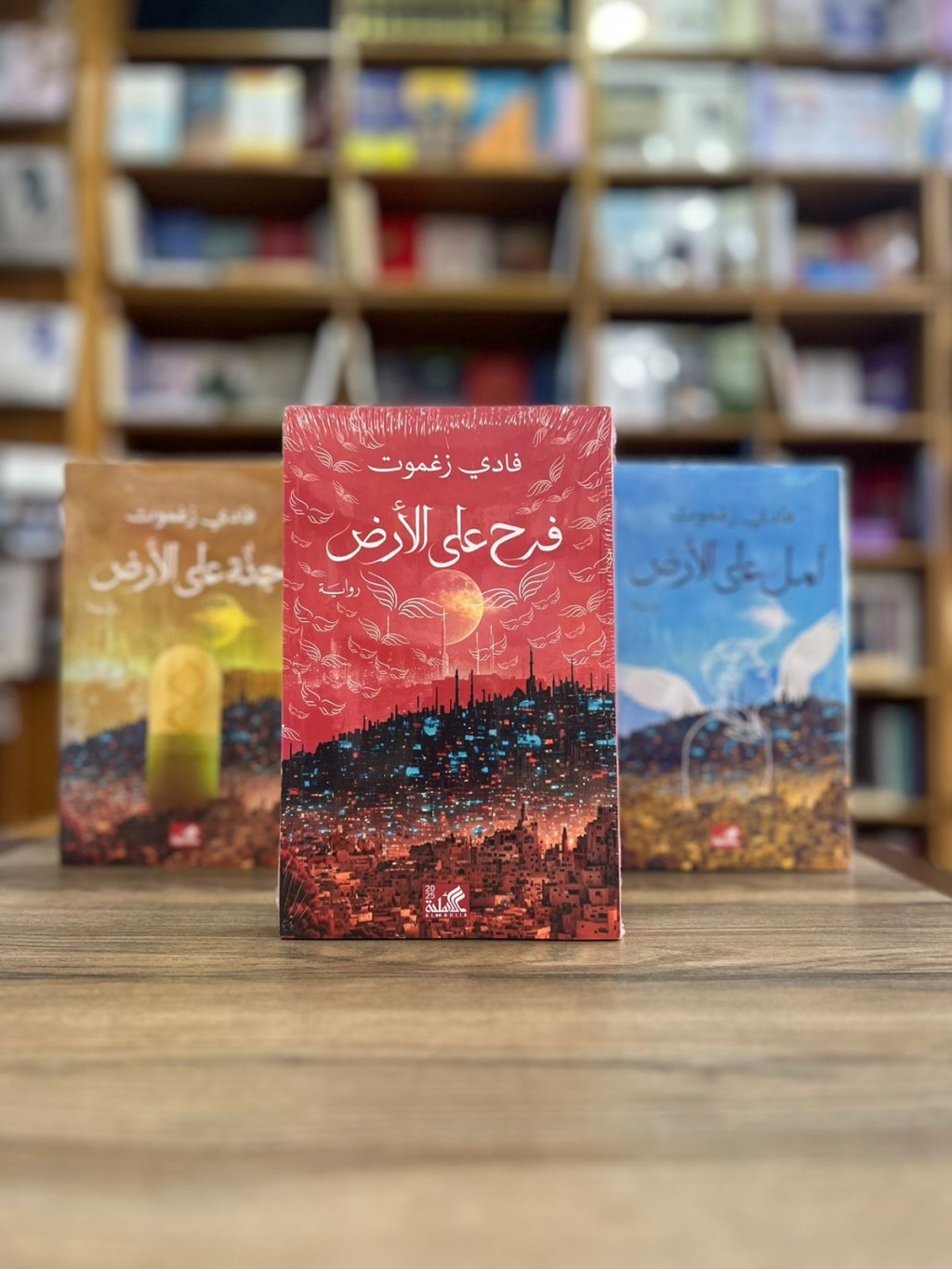
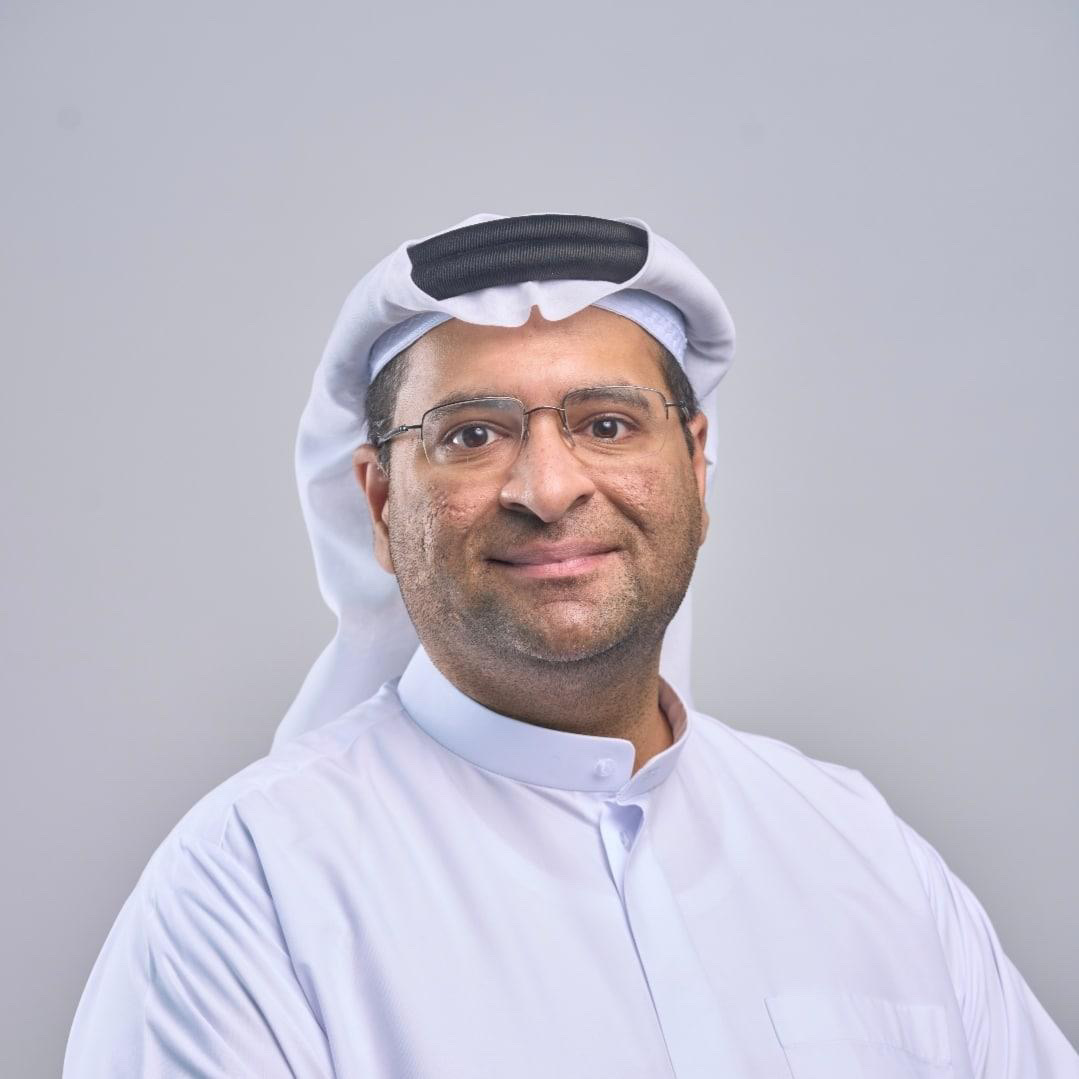
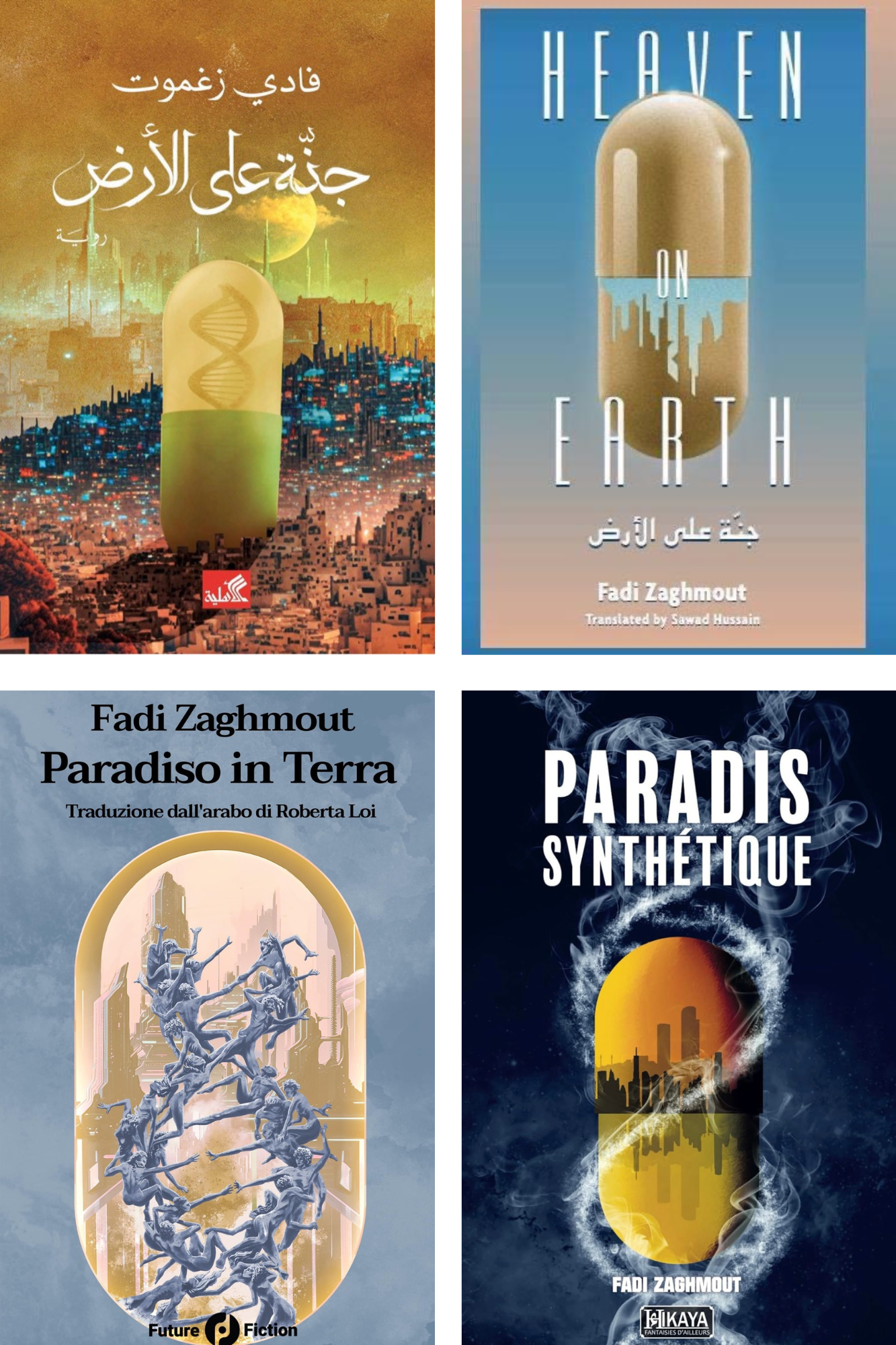
About two weeks ago, Ali reached out to me on Instagram. He had just started reading Janna Ala Al Ard (Heaven on Earth) and was already halfway through the book, brimming with excitement. What made it even more special was that he immediately ordered the sequel and the final book in the trilogy—and went on to write three thoughtful reviews on Goodreads, one for each book.
I was genuinely humbled by his passion for the story and by his excitement about reading Arabic science fiction. When he finished the trilogy, he told me he wished he could write more about it. I suggested he do exactly that and asked whether he’d be interested in contributing a piece to my website. Thankfully, he agreed. What he wrote is a beautiful reflection—proof that Ali is not only a passionate reader with a vivid imagination, but also a very good writer in his own right.
A Journey of Eternal Youth

In his Eternal Youth Trilogy, Fadi Zaghmout offers a vision of a future that, at first glance, seems unreachable, almost unfathomable; a future without old age.
Part One: A New Age
You walk and hear your knees crackling, while the nerves in your shoulders steadily serve you with pain signals. You wince in quiet pain, yet nothing is odd, as such sensations have grown over time and have intertwined with your existence over the many years you have lived. Occasionally, your heart aches for an unbound future as you desire to fulfil the dreams of days long gone, but you quickly come to accept the bound reality of your deteriorating body, and the inevitable path of old age. After all, this is the natural order of life, isn’t it?
In his Eternal Youth Trilogy, Fadi Zaghmout offers a vision of a future that, at first glance, seems unreachable, almost unfathomable; a future without old age. With a simple choice of taking one yellow pill, the ultimate death spell of old age is no longer a threat, as your body filters through the decaying cells with the support of technology. It maintains its youthful state, reversing any damage or disease caused by old age. This is only the beginning of a journey into a near future that seems so far removed from our current reality.
However, With Zaghmout’s skillful use of language, coupled with the immense research he has conducted on the topic of technology and the human body, you are presented with a painting that embodies far more reality than initially expected. The experience of reading this trilogy sweeps you away into questioning some core concepts that we take for granted, as it combines scientific research with philosophical conundrums that have haunted humanity since they have come into being. In this immense work by Zaghmout, many themes are discussed, as he doesn’t shy away from tackling multiple controversial topics over the course of the trilogy. My goal here is to zoom in onto three key themes which have resonated with me the most.
At what point do we as humans decide that other choices are “wrong” and seek to rectify them? When do we start clouding our selfish desires under the name of love? If technology serves our path but not those of who we love, does this give us the right to take away core choices from them in the name of advancement and progression?
Part Two: Choices
The first book starts with a deceptively simple premise – that of an ageing brother and sister who differ on one fundamental choice: to take this yellow pill and regain youth and live for many years to come, or to abstain from this pill and progress into the disease riddled lands of old age that we have grown to accept as inevitable reality.
Our collective human history, and the road we carve ahead is comprised of a tapestry of choices. Our core memories, often, are also a spiral of pivotal choices. As humans, we are born with so much that we do not control – our DNA, our mental capacities, our environment and the people that come into our early phases of lives, and so much more. We often try to navigate the maze of life in an attempt to define a path for ourselves, and there is nothing like a choice that we consciously make to help us feel a sense of control, freedom, and purpose amidst a world of chaos.
Suppose though that a person you love very dearly makes a choice that will take them away from you, permanently. Case in point; Jamal, the brother, decides to age naturally, away from any pills or scientific interventions. Janna, the sister, chooses life and youth like many others. This drives the central conflict within Zaghmout’s narrative, as Janna can’t accept Jamal’s choice. We are introduced to a plethora of characters connected to Janna and Jamal, all battling with their own demons as they try to understand this new life in which old age goes nearly extinct. Zaghmout excels in presenting ideas and choices, without ever preaching a specific path. You remain with him on a parallel vantage point, looking at a new society that is taking its wounds into a new age.
At what point do we as humans decide that other choices are “wrong” and seek to rectify them? When do we start clouding our selfish desires under the name of love? If technology serves our path but not those of who we love, does this give us the right to take away core choices from them in the name of advancement and progression? These questions merely scratch the surface as the narrative builds a foundation and starts to introduce so many new ideas involving technology and its impact on the society, with each choice further elevating the stakes. On the other side of the mirror of choice, lies judgement. Judgement comes from those who merely glance at us, but also from those who cherish us (sometimes they judge because they love us, right?!). Zaghmout handles the connection between choices and judgements very well as he invites us to understand his troubled cast of characters, from those who want to reinvent their lives, to those who seek a return to childhood – yes, returning to an earlier age, with or without your memories, is actually a viable choice, which brings me to the second theme.
Gone. No more age. No more “wisdom of the old”. No more reminiscences about innocent childhoods and yearning for kind grandparents, because almost all now walk around with the same vigour of youth. Would you be able to interact the same way with your father if he looked exactly like your age?
Part Three: Infants of Wisdom
Imagine a future in which age is irrelevant, and you can choose the age at which you stay at, even if it means going back to childhood. You walk besides an “adult” as a chubby little baby, but in fact you are far older and have life experience! Imagine a marriage in which the husband is acting like a teenager as he decided to go back to that age of hormones and discovery, while the wife decides to stay as an adult, almost acting as her husband’s mother. Further yet, imagine that you adopt an infant who used to be a respectable adult, only for him to turn into an entirely different person when you raise him.
Our social construct is built entirely on the concept of age – the whole education system is built on the progression through different age groups and levels, and you are expected to build a career henceforth, and to create a family, at specific checkpoints determined by your age. Oh, how come that guy is a director at only 32 years old! Oh, wow that young girl was able to invent a new device at only age 17! How many articles have you read that anchored their dramatic impact on the concept of age? Even our behaviours and attitudes change significantly when we interact with children instead of adults. The kindness and tolerance we possess are disbursed differently across the young and the old.
Gone. No more age. No more “wisdom of the old”. No more reminiscences about innocent childhoods and yearning for kind grandparents, because almost all now walk around with the same vigour of youth. Would you be able to interact the same way with your father if he looked exactly like your age? We often excuse children for some behaviours, given they are just learning the ropes of life – will you do the same for an eternal child, knowing deep down that this child can be older than you, just because they look small and fragile? To what extent are we willing to disassociate imagery from reality, and to deny what our brain perceives as the truth based on social norms we have grown to embrace since the dawn of humanity?
This is a philosophically rich work, and it never rests on one idea as it continues to introduce new complications, one of which is the organization that takes the mantle on itself to represent divine judgement!

What if AI studies all the rules and simulates the process of judgement? In this bleak vision, Zaghmout envisions an organization that randomly selects individuals to “die”, which in the context of this world means that they sleep for one hundred years. Then, across a faraway place in the sky, they go into this induced sleep, and experience either heaven or hell based on their deeds, as visualized in the holy books.
Part Four: Dystopian Faith
The third theme, which perhaps for me has been the most haunting within the narrative, is how humans can combine technology with an extreme faith system to create a living nightmare. This theme emerges in the second book and goes on full steam in the final book. While being perhaps the most controversial theme, it carries the most impact. Almost any religion inherently is driven by the concept of good deeds and bad deeds and is fuelled by a reward / punishment system. Fundamentally, in most religions, the belief is that there is a higher being, God, who will judge us justly and mercifully, and that we should be confident that if we do good deeds and have good intentions, we should be assured of a good life after death.
What if AI studies all the rules and simulates the process of judgement? In this bleak vision, Zaghmout envisions an organization that randomly selects individuals to “die”, which in the context of this world means that they sleep for one hundred years. Then, across a faraway place in the sky, they go into this induced sleep, and experience either heaven or hell based on their deeds, as visualized in the holy books. Who will record the acts you ask? Well, of course the AI designs two angels on each person’s right and left shoulder so that they simulate the entire process! Let us not forget that humans have designed all of this, and I leave it up to your imaginations as to what kind of horrors ensue when such power and control is given to those who want to drive personal agendas and outcomes.
In a world that has nearly overcome death, humans invent a way to die. This really raises a critical question – do we seek death, as much as we fear it? There are some practical implications of reduced death rates, such as over population, which can justify implementing a “death system”, but this goes much further. What Zaghmout really tackles here is our existential crisis and our strange relation with death, and our visualization of a life beyond the grave. Characters in the story carry on living, sometimes as AI programs into man-made bodies, and can possibly encounter themselves in different formats but with the same core identity. In such a strange and surreal world, what does death even mean if a route back is possible?
The last book in the trilogy makes us experience a man-made hell, which had me shuddering in horror. Yet we see humanity across the ages committing some truly horrific acts and massacres. In some sense, such an evolution seems rather realistic and in line with our tainted legacy. We are creatures of polarity, at once benevolent yet brutal; at once ambitious yet regressive, and at once in love with life yet fascinated by death. At the end of my reading journey, I found myself deep in thought as I stared into empty space, processing the journey that started with a simple seed of a yellow pill that grew into a massive tree, impeccably rooted by the immense master mind of Fadi Zaghmout.
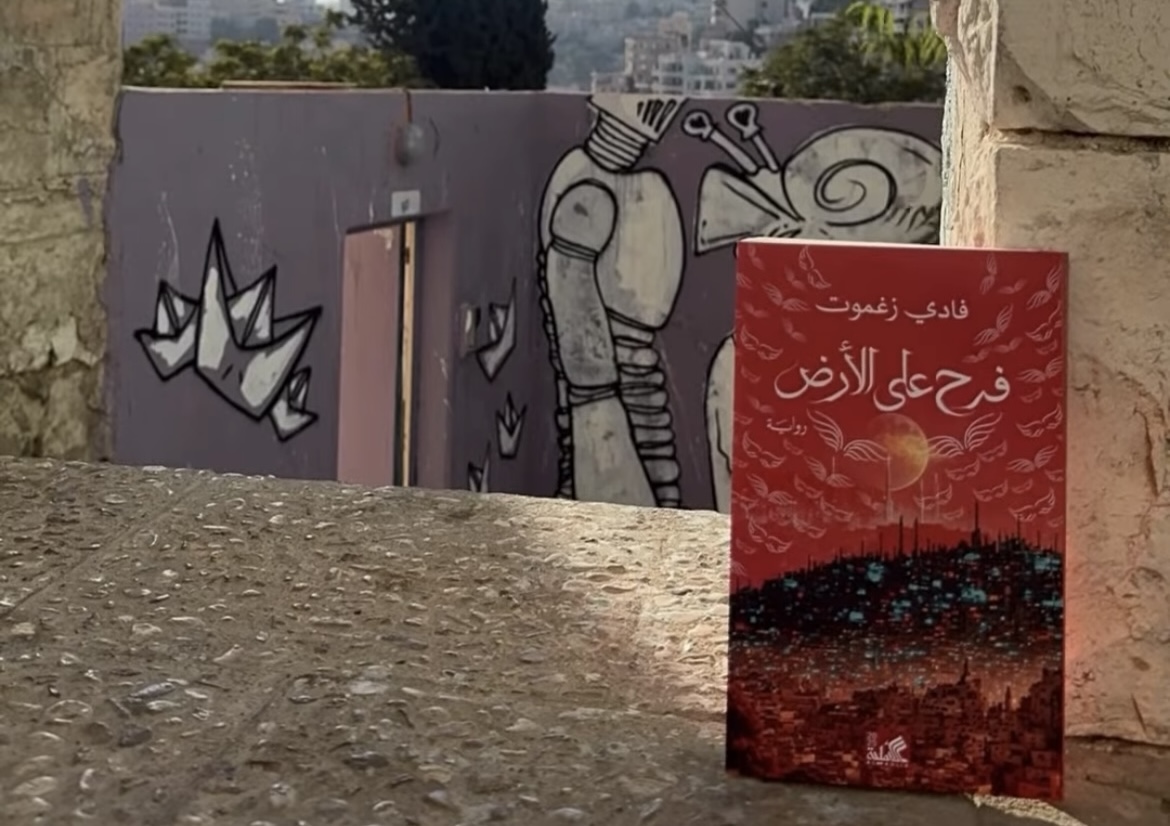
Zaghmout has created a fully realized vision and a master work of social science fiction that challenges yet never judges.
Part Five: Eternal Roots
There are so many other branches to this tree, and many themes which I have not touched on such as gender roles in such a society, the nature of human interactions in a fully realized virtual world, and even how humans continue to utilize those less fortunate as ways of entertainment through reality shows. Zaghmout has created a fully realized vision and a master work of social science fiction that challenges yet never judges.
The concept of eternal youth has been handled in literature before, but very rarely has it been addressed at the social level. So much of what we deem acceptable is reversed, and vice versa. Zaghmout expertly presents a dilemma after one, without ever taking the easy route of injecting his judgement. You, the reader, will decide for yourself what to take from this tale. Isn’t this after all why we consume literature? To push our own understanding and to allow us for time to reflect on our own choices, judgements, and existence?
You open an old rustic door to see your family awaiting your return. After many hugs, you all sit next to a warm old-fashioned fireplace, conversing about the day’s adventures as you overlook your beautiful farm outside. You heartly eat a delightful home cooked dinner, and step outside. As you head towards the grazing sheep, you feel the gentle breeze breathing life into your tired body. The echoes of playing children merge with the call for prayer travelling from a distant mosque. As the sun starts setting, you find a quiet corner to pray and thank God for the day’s blessings as you bathe in the orange hues of the sky. Your hands touch mud as you kneel, while your nose inhales the earthly smell. You raise your head, and suddenly the AI empowered device in your eyes gets deactivated, and you see yourself inside a lonely spaceship, overlooking Earth – no one to hug. The the muted sounds of space envelope you as you realize the truth of your whereabouts.
This is not a scene from the trilogy, but something that my mind has conjured up as I started to imagine the possibilities of life in such a future. If my virtual existence provides me with all the sensations that a “real” experience provides, then does my true reality actually matter?
The human mind seems to always be capable of generating new experiences and technologies to compensate for an increasing sense of loneliness. There is something about the simplicity of a short but well lived life that attracts us, as it provides a deep sense of purpose and closure. Our realities can shift and change, but our core needs remain one and the same, eternally.


Do you have something to say?